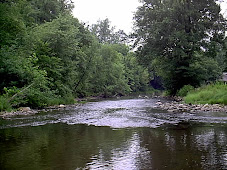
Harrisburg – The departments of Environmental Protection and Health, and the Fish and Boat Commission have lifted the “Do Not Eat” consumption advisory for all species of fish taken from Pymatuning Reservoir and Tamarack Lake in Crawford County.Fish tissue samples tested by the Fish and Boat Commission and Cornell University determined the large fish kills in both lakes were the result of a Columnaris outbreak. Columnaris is a naturally occurring bacterium that was triggered by several stressors, including rapidly warming waters during the spawning season.
Wednesday, June 23, 2010
Pymatuning fishkill resolved

Monday, June 7, 2010
High water, no problem
A lot of guys find that high water blows them right out of their game. Some won't even fish in high water. Listen, it's not like the fish can go check into the nearest Howard Johnson's for a vacation. They are there, it's your job to find them.
Check the current seams. You will find slack water and that's where the fish will stack in order to avoid swimming hard against the current all day. I remember fishing Neshannock Creek once years ago when the water was so high the dam in Volant was not noticeable. I'd driven a long way so I had to try something. You know that abutment on the side of the dam that people climb on? the water was that high, so I found a little eddy that had formed in it, tied on a heavy bead-head Pheasant tail nymph, and caught 3 fish in it!
Don't give up, just fish smarter. :)
Check the current seams. You will find slack water and that's where the fish will stack in order to avoid swimming hard against the current all day. I remember fishing Neshannock Creek once years ago when the water was so high the dam in Volant was not noticeable. I'd driven a long way so I had to try something. You know that abutment on the side of the dam that people climb on? the water was that high, so I found a little eddy that had formed in it, tied on a heavy bead-head Pheasant tail nymph, and caught 3 fish in it!
Don't give up, just fish smarter. :)
Wednesday, April 21, 2010
Guide to Discus by Heiko Bleher

In reviving this place for the Spring/Summer (dare I dream even more?) I wanna remember that the name is "Adventures with Fish", not just fishing, and with that in mind here's a great start to a new series on Discus keeping by a man who knows them better than most of us ever will.
With Practical Fishkeeping, Heiko Bleher is presenting a series on Discus that judging by part one, will be a superb in-depth look at one of my favorite fish! Here's a sample:
All three species of Discus can easily be distinguished by their own chemical water parameters and that’s why I recommend never keeping them together.The habitat of Heckel Discus (S. discus) is always water of a dark tea colour, with visibility up to 1m/3.3’ and rarely more; pH never above 5.0 but averaging 4.5; conductivity from 6-12 µS/cm — but the average is always below 10. They live only in extreme acid water and oxygen concentration is often only 2.8 mg/l.
Heckels are active in daytime in groups of 30-200 or even more, standing in deep water, along rivers, or lake edges at a drop-off, normally at a depth of 1.5-4m/5-13’ among mostly acará-açú bushes (Licania spp.), a plant widespread in the Amazon basin and living partly under water.
In between are fallen trees and logs — and there’s always fine white sand present too.


Check it out, it's a great introduction that has me already looking forward to the rest of the series!
Monday, April 12, 2010

Thursday, February 18, 2010
Practicing L.N.E. Leave No Evidence
Spring must be getting a little closer because I'm getting that itch. No, not that itch. I showered this week. I mean that itch to fish!
The first week of March usually is a great time at my favorite hybrid Striped Bass spot too and that's getting near. In addition, I picked up one of these neat Tackle Trolleys and in sorting my gear I remembered just how long it has been since I've been on the water. I also remembered something else. I remembered that my favorite hybrid Striper spot has an ongoing major problem: litter.
You've seen it, experienced the disappointment of heading to the water for that precious time of wrestling with nature and found nature adorned with trinkets nature didn't design. Soda and beer cans, candy bar wrappers, balls of fishing line, empty cigarette packs, bait containers and just about anything else you can imagine.
Here's what I've been practicing and something that I hope you'll adopt as well. I like to call it "Leave No Evidence". The idea is that when we hit a spot to fish or to hunt or whatever reason, we leave it without evidence that we or anyone else has been there. What I mean is that we carry a bag with us for trash and not only use it for our own garbage, but pick up something that someone else left behind. It doesn't even need to be a full sized trash bag that you bring. It can be one of those small grocery bags that you're using to carry your soda and sandwich. What you use is up to you.
Don't throw your trash on the ground or in the water. Put it in the bag and keep it 'til you reach the nearest trash can, or take it home if you don't see one. Don't stop there! Pick up something someone else left behind. Make the place you use better for your having been there. It just takes a little effort and helps everyone, including the animals you are there to find.
A little addressed fishing issue that I include under "L.N.E." is proper treatment of fish. Don't do like some folks do and handle fish abusively. If you aren't going to keep them, throwing them 20 feet so that they make a big splash upon hitting the water is a good way to kill them, and that leaves evidence. Release them gently so they can grow bigger and be caught again someday.
If you're using minnows, remember that it's bad for the body of water you're fishing to release baitfish there which weren't caught there. Those foreign minnows could be carrying diseases or parasites for which the natives have no defense. This is an illegal action in many areas too, and you could end up with serious fines.
So, leave no evidence that you've fished a spot, except, to leave it better than when you arrived! Feel free to leave your ideas in the comment section. :)
The first week of March usually is a great time at my favorite hybrid Striped Bass spot too and that's getting near. In addition, I picked up one of these neat Tackle Trolleys and in sorting my gear I remembered just how long it has been since I've been on the water. I also remembered something else. I remembered that my favorite hybrid Striper spot has an ongoing major problem: litter.
You've seen it, experienced the disappointment of heading to the water for that precious time of wrestling with nature and found nature adorned with trinkets nature didn't design. Soda and beer cans, candy bar wrappers, balls of fishing line, empty cigarette packs, bait containers and just about anything else you can imagine.
Here's what I've been practicing and something that I hope you'll adopt as well. I like to call it "Leave No Evidence". The idea is that when we hit a spot to fish or to hunt or whatever reason, we leave it without evidence that we or anyone else has been there. What I mean is that we carry a bag with us for trash and not only use it for our own garbage, but pick up something that someone else left behind. It doesn't even need to be a full sized trash bag that you bring. It can be one of those small grocery bags that you're using to carry your soda and sandwich. What you use is up to you.
Don't throw your trash on the ground or in the water. Put it in the bag and keep it 'til you reach the nearest trash can, or take it home if you don't see one. Don't stop there! Pick up something someone else left behind. Make the place you use better for your having been there. It just takes a little effort and helps everyone, including the animals you are there to find.
A little addressed fishing issue that I include under "L.N.E." is proper treatment of fish. Don't do like some folks do and handle fish abusively. If you aren't going to keep them, throwing them 20 feet so that they make a big splash upon hitting the water is a good way to kill them, and that leaves evidence. Release them gently so they can grow bigger and be caught again someday.
If you're using minnows, remember that it's bad for the body of water you're fishing to release baitfish there which weren't caught there. Those foreign minnows could be carrying diseases or parasites for which the natives have no defense. This is an illegal action in many areas too, and you could end up with serious fines.
So, leave no evidence that you've fished a spot, except, to leave it better than when you arrived! Feel free to leave your ideas in the comment section. :)
Friday, February 5, 2010
in PA news
Increased poaching penalties...a youth dies while hunting raccoon...a Steelhead seminar tomorrow...and a meeting of Trout Unlimited....check it all out here!
Hunting with Eagles, see eagles catch deer and wolves
Absolutely amazing. Ok, I know this is off-topic, but it was too stunning not to share and I aian't startin' a hunting blog. ;)
On this guy's Flickr page, a video clip of hunting deer using an eagle!
This Youtube video is of ancient hunting techniques using eagles to hunt wolves. Wow, this so dwarfs my memory of being 9 years old and watching an eagle grab a kitten just about 3o yards from me. Warning: the Youtube video is not for the faint of heart, some scenes will be disturbing for some people!
On this guy's Flickr page, a video clip of hunting deer using an eagle!
This Youtube video is of ancient hunting techniques using eagles to hunt wolves. Wow, this so dwarfs my memory of being 9 years old and watching an eagle grab a kitten just about 3o yards from me. Warning: the Youtube video is not for the faint of heart, some scenes will be disturbing for some people!
Subscribe to:
Posts (Atom)